
33.2 C
Jammu
Wednesday, August 12, 2026

DC Kathua reviews road safety measures on National HighwayOn-ground assessment conducted; engineering and traffic management measures proposedKATHUA, FEBRUARY 17

DC Kathua reviews road safety measures on National Highway
On-ground assessment conducted; engineering and traffic management measures proposed
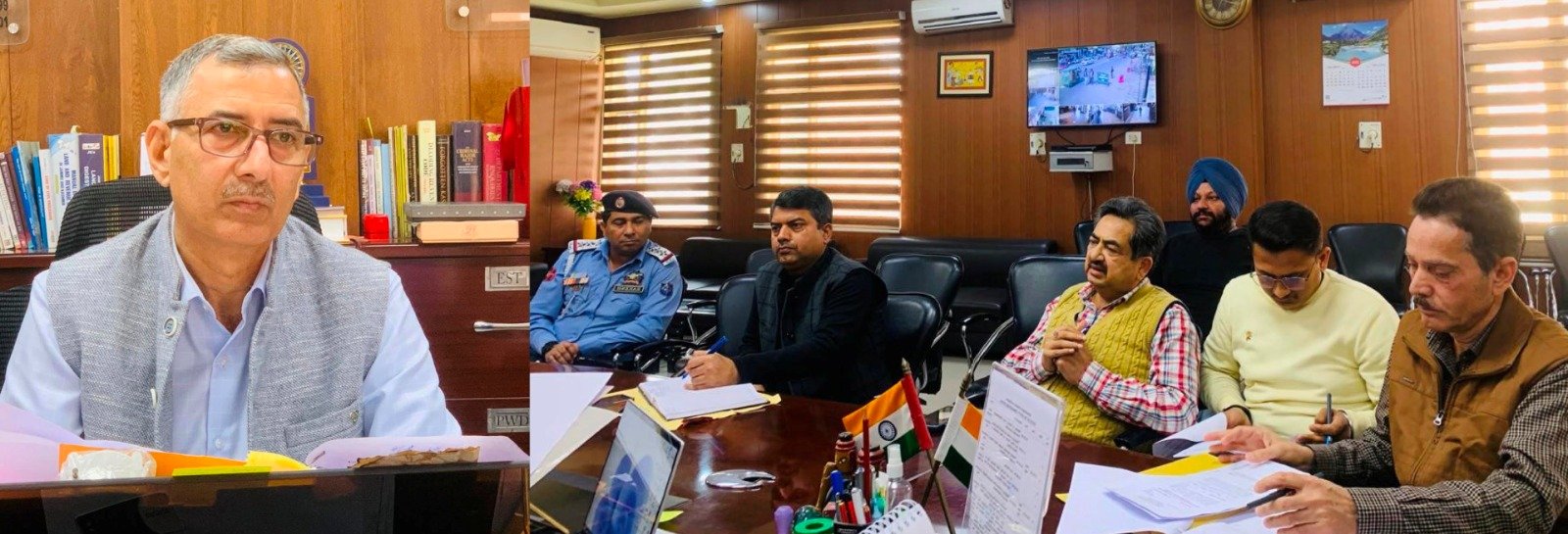
KATHUA, FEBRUARY 17: Deputy Commissioner Kathua, Rajesh Sharma, today chaired a meeting to review identified black spots on the National Highway passing through the district and to finalise a comprehensive proposal for submission to higher authorities seeking necessary intervention from stakeholders, including the National Highways Authority of India.
The meeting was informed that a detailed on-ground inspection and technical assessment of accident-prone locations has been undertaken along the 39-kilometre stretch of the National Highway within the district. The exercise focused on identifying structural gaps, traffic management steps and other vulnerabilities contributing to road mishaps.
The committee members highlighted critical locations witnessing frequent accidents, particularly at cross sections, junctions, link roads, tunnels, merging points and high-speed corridors. Emphasis was laid on traffic channelisation, installation of crash barriers and ensuring adequate lighting at vulnerable spots.
Deliberations were held on short-term measures such as installation of retro-reflective signages, road markings, speed calming interventions, caution boards and improving visibility at blind curves. Long-term engineering solutions, including geometric corrections, widening of bottlenecks, construction of service lanes, strengthening of shoulders and redesigning of intersections, were also discussed.
The Deputy Commissioner directed the concerned departments to compile field inputs, technical observations and photographic documentation into a detailed, time-bound proposal for submission to higher authorities to facilitate approval and execution of major corrective works by the National Highways Authority of India.
He further stressed close coordination among PWD, Traffic Police, Transport Department and National Highway representatives to ensure immediate implementation of feasible safety measures, alongside continuous monitoring of identified black spots to assess reduction in accident rates.
Pertinently, a committee headed by the Superintending Engineer, PWD Kathua, with members including the Regional Transport Officer, District Traffic Inspector and representatives of the National Highways Authority of India, has been constituted to examine the black spots and recommend remedial measures to substantially curb road accidents along the National Highway stretch falling within the district.
Previous article
Next article
Budget Session 2026Assembly ProceedingsHouse passes grants for Agriculture Production, Rural Development, Cooperative and Elections DepartmentsJavid Dar terms agriculture as ‘lifeline of J&K’s economy’; announces Viksit village in every Assembly ConstituencyJAMMU, FEBRUARY 17: The Jammu and Kashmir Legislative Assembly today passed grants totalling Rs. 4,56,569.56 lakh for Rural Development and PR, Rs. 2,42,386.40 lakh for Agriculture, Rs. 1,16,040.98 lakh for Animal and Sheep Husbandry, Rs. 69,648.23 lakh for Horticulture, Rs. 20,620.56 lakh for Fisheries, Rs. 26,611.42 lakh for Cooperatives and Rs. 36,126.71 lakh for the Election department.The grants were passed through a voice vote after day long deliberations by the Legislators in the House.Winding up the discussion on Demands for Grants, Minister for Agriculture Production, Rural Development, Cooperatives and Election, Javid Ahmed Dar, described agriculture and allied sectors as the “lifeline for Jammu and Kashmir’s economy,”. He emphasised that these sectors are central towards sustained rural livelihoods, generating employment, strengthening food security and ensuring inclusive economic development.Highlighting the economic significance of Agriculture sector, the Minister informed the House that agriculture and allied activities contribute ₹41,273 crore to Jammu and Kashmir’s economy, accounting for 19 percent of the SGDP (Ministry of Statistics 2024–25). Of this, horticulture contributes 41 percent, reaffirming Jammu & Kashmir’s leadership in high value fruit production. Livestock contributes 33 percent, while core agriculture accounts for 25 percent ensuring food security and sustaining traditional cropping systems, he said.He stated that the government has adopted a dual strategy, strengthening the agricultural infrastructure while simultaneously empowering the farmers through beneficiary driven interventions. “Public investment must translate into measurable prosperity at the grassroots level,” he said.The Minister said that under UT Capex, flagship schemes such as the High-Density Plantation Scheme, Integrated Dairy Development Scheme, Integrated Sheep Development Scheme and Integrated Poultry Development Programme are being implemented in mission mode.“These efforts, reinforced by transformative interventions under HADP and JKCIP, are not merely budgetary allocations, they are driving real change on the ground. Together, they are modernizing the production systems, promoting rural enterprises, strengthening value chains and ensuring that public investment translates into tangible benefits for our farmers’, he said.The Minister also said that J&K has decisively moved away from subsistence-oriented practices towards a diversified, climate-smart, technology-enabled and income-focused agricultural model, adding that the results are both measurable and encouraging.“As a direct outcome of sustained capital infusion through HADP, JKCIP and other capex initiatives, our net cultivable area has expanded by nearly 80,000 hectare, increasing from 12.71 lakh hectare to 13.50 lakh hectare, a clear reflection of renewed confidence and productive expansion in the sector”, maintained the Minister.The Minister added that government’s push towards vertical farming and protected cultivation has yielded remarkable results, with establishment of 332 hi-tech greenhouses and 848 polyhouses covering an area of 30 hectare. He said that this infrastructure has boosted cropping intensity to 250 percent while significantly safeguarding the crop yields from climate volatility.“Our focused and strategic push towards oilseed promotion has yielded significant results. The area under oilseeds has expanded from 1.4 lakh hectare to 2.1 lakh hectare, leading to a near doubling of production”, he said.The Minister further said that the expansion in area under oilseeds, particularly the large scale cultivation of mustard helped in 77 percent growth of apiculture.“Honey production has crossed 3,895 MTs, supported by distribution of over one lakh bee colonies and establishment of 11 honey processing units under Honey project of HADP, creating new income opportunities for the farmers and rural youth”, he said.The Minister said that the Mushroom cultivation has increased by 31 percent over the past three years, with production rising from 2,100 MT to 2,742 MT through establishment of 227 units and distribution of 1.18 lakh compost bags.The Agriculture Minister further said that the Horticulture sector remains top priority of the government, adding that the strength of our rural economy is closely tied to the strength of our orchards.“To achieve our ambitious target of expanding High-Density plantations across 5,500 hectare, we are developing robust rootstock banks and mother orchards under Project 21 of HADP, laying a strong foundation for self-reliance and long-term orchard sustainability”, he said.The Minister also said that the Fruit production has increased from 26.43 lakh MT to 26.92 lakh MT and the government is firmly committed to achieve 29.72 lakh MT production by 2029–30. He added that during 2026–27 alone, an additional 1,455 hectare will be brought under high and medium-density plantations, further accelerating growth.To strengthen the planting material self-sufficiency, the Agriculture Minister said that a mega fruit nursery at R.S. Pura has been commissioned with an annual capacity of 5 lakh quality saplings, adding that two elite nurseries and Plant Establishment Quarantine facilities are being developed at Marta (Udhampur) and Lehwan (Anantnag) to ensure disease-free, high-quality planting material.For conservation and genetic preservation, he said that SKUAST Jammu has established a State-of-the-Art Ex-Situ Gene Bank, becoming only the third institution in India to develop such a facility. This is definitely a milestone that will safeguard the rich horticultural biodiversity for future generations.The Minister said that 15,000 metric tonne of new CA capacity will be added during the current financial year recognising the critical importance of Controlled Atmosphere (CA) storage for our fruit economy.“Jammu and Kashmir currently has 37 mandis, with 24 fully operational and the remaining 13 in various stages of development. Significantly, of the 19 wholesale mandis, 17 have already been integrated with the e-NAM platform while integration of the remaining two is underway. Since inception, over 55,000 stakeholders have registered and a cumulative trade worth ₹1,721 crore has been conducted up to December 2025”, he said.The Minister further said that under the Integrated Dairy Development Scheme, 937 dairy units were established during 2025–26, generating employment for nearly 2000 individuals and significantly strengthening the dairy ecosystem across the Union Territory.He said that under Integrated Sheep Development Scheme, 2018 units were set up in 2025-26, enhancing breed improvement, meat production and sustainable livelihood opportunities for shepherd families and rural youth.“For the first time in the history of Jammu & Kashmir, 900 elite mutton-purpose sheep of the Texel and Dorper breeds have been imported from Australia, marking a major milestone in strengthening our livestock sector”, he said.The Minister said that under Dairy Development Project of HADP, the government has adopted a mission mode approach to significantly enhance the milk productivity and farmer incomes. Currently, Jammu & Kashmir produces around 30 lakh metric tonnes of milk annually (ISS 2024-25). He added that the government has set an ambitious target to increase this productivity to 43 lakh metric tonne by 2030, moving towards making J&K a net milk exporter.The Minister also informed the House that for the first time ever, Jammu & Kashmir has imported 40 high genetic merit breeding bull calves from the United States of America. He added that this initiative is truly a game changer, which will enhance the milk productivity, raise farmer incomes, generate employment and make J&K self-reliant on Dairy.Highlighting that digital empowerment is redefining agricultural governance in J&K, the Minister said that under the visionary leadership of Chief Minister, the government has launched the JKCIP Portal, the Credit Scheme Advisor, the HADP 360 Portal, a unified one-stop platform for all agriculture schemes, and an Online DPR Generator, ushering a new era of transparency, efficiency and ease of access for our farmers and agri-entrepreneurs.“Through 1,300 operational Kisan Khidmat Ghars, the government is ensuring technology-driven last-mile delivery. More than 8 lakh farmers have been on-boarded onto the Kisan Sathi and KKG platforms”, he said.The Minister further said that protecting our farmers from risk is one of our top priorities, adding that 2.01 lakh farmers covering 75,732 hectare were enrolled during Kharif 2025 under the Pradhan Mantri Fasal Bima Yojana.He highlighted that financial year 2026–27 will mark a defining chapter in transformation of agriculture and allied sectors in Jammu & Kashmir. “With a bold vision and firm resolve the government is ushering in a new era of opportunity, productivity and prosperity for our farmers”, he said.The Minister also announced the launch of an Aromatic and Medicinal Plants Mission with a total financial outlay of ₹150 crore, for which ₹10 crore have been allocated in the coming financial year. He added that this mission will harness the vast natural potential of Jammu & Kashmir, promote cultivation of high-value aromatic and medicinal crops, and create significant livelihood and income generation opportunities for our farmers and rural youth.For support of horticulturalists and safeguard them against weather-related uncertainties, the Minister also announced implementation of the Restructured Weather Based Insurance Scheme (RWBIS) in Jammu & Kashmir, adding that the scheme will cover Apple (both traditional and high-density plantations) and Saffron in the Kashmir Division and Mango, Litchi and Saffron in the Jammu Division, with a total sum insured of ₹6,594.93 crore.He said that the government will provide a 25 percent top-up subsidy to promote micro and sprinkler irrigation systems and for this purpose, the government has earmarked ₹116.86 crore in the current financial year. He added that this initiative is expected to improve water-use efficiency by 60% to 80%.The Minister also said that we will establish a Centre of Excellence in every district of Jammu & Kashmir for production of high-quality vegetable and floriculture planting material. He added that 1,455 hectare shall be covered under high and medium density plantations and public/private nurseries shall produce 8 lakh planting materials and 17.84 lakh rootstock plants to feed area expansion. Besides, 6 hectare of mother orchards, 15 hectare of rootstock banks and 40 hectare of plant propagation units will be established to further strengthen the supply chain.The Minister added that this Ministry aims to establish 38000 MT CA capacity in 2026-27, adding that to promote balanced regional development, the government will prioritize top-up subsidy for Controlled Atmosphere (CA) storage units in districts other than Pulwama and Shopian, where capacity has already saturated. “To achieve this, 40 new CA stores with an estimated investment of ₹1,400 crore will be established, of which, the hovernment will provide ₹600 crore as subsidy, with top-up support available from 2026–27 onwards”, he said.In a major push to dairy economy, the Minister also proposed establishment of seven Milk Processing Plants of 1 lakh litre per day capacity, with an investment of approximately ₹770 crore through UT Capex and Government of India support. “ The J&K government will be among the first UTs and States to invest in milk value addition sector in addition to the grants from GoI. This initiative will benefit 9 lakh dairy farmers and act as a robust step to increase milk processing capacity of J&K from the current 4 percent to 25 percent in the coming years”, he said.To accelerate formalization and modernization of dairy sector in Jammu & Kashmir, the Minister said that a 15 percent top-up subsidy has been proposed under Integrated Dairy Development Scheme over and above the support provided under PMFME scheme for establishing new milk value addition units. This incentive aims to complement PMFME over the next five years. “The UT targets the establishment of 1,000 new milk value addition units by supporting 200 units annually through this top-up subsidy. Once operational, these units are projected to process approximately 3.00 lakh litres of milk per day, significantly boosting organized milk processing and value addition capacity across the region”, he said.The Minister further said that the department is expanding Sheep sector through assisted breeding technologies and during 2026-27, department is importing 900 Romanov and Fin sheep and 900 high-quality milk producing Swiss Alpine and Boer goats.He added that the government is actively considering the launch of a new scheme, “PAWAN”, aimed at the collectivisation of wool farmers through a structured three-tier cooperative model. The scheme will focus on aggregation, primary processing and organized marketing of wool, ensuring better price realization and strengthening the wool value chain across the Union Territory, he added.The Minister further said that the Rural Development department forms the institutional backbone of grassroots governance and inclusive rural transformation in Jammu & Kashmir. “Rural Development and Panchayati Raj are not merely administrative subjects; they are instruments of economic empowerment, social justice, employment generation, infrastructure creation and participatory democracy across our villages”, he stated.The Minister said that the vision of government is to transform rural Jammu & Kashmir into vibrant and self-reliant communities, achieving balanced development through effective governance, community participation and sustainable resource management.He said that during previous year the government has strengthened wage security and rural asset creation at an unprecedented scale under Mahatma Gandhi National Rural Employment Guarantee Act (MGNREGA). During 2025–26, Rs387.37 lakh person-days have been generated, directly boosting the rural incomes.He added that under Pradhan Mantri Awas Yojana-Gramim (PMAY-G), 15,093 houses have been completed during the current financial year, taking the cumulative number of houses completed to 3.23 lakh, achieving 97 percent of the overall target, thereby reinforcing housing security and improving the quality of life for rural households.Under Swachh Bharat Mission (Gramin), the Minister said that 27,775 Individual Household Latrines have been completed and 1,954 Community Sanitary Complexes have been constructed while 553 are under progress and would be completed by March 2026. He added that under Solid Waste Management, 2,662 community compost pits and 118 segregation sheds have been installed, with 106 segregation sheds under progress and shall be completed by March 2026.The Minister further said that under Grey Water Management, 3,673 community soak pits and 22 Decentralized Wastewater Treatment Systems (DEWATS) units have been installed so far, while 76 DEWATS are under progress and shall be completed by March 2026. He added that 2 bio gas plants under GOBARdhan have been completed and 12 are under progress and shall be completed by March 2026. Besides, 17 Faecal Sludge Treatment Plants (FSTPs) are under progress and expected to be completed by March 2026.Under Rashtriya Gram Swaraj Abhiyan, he said that 214 Panchayat Ghars have been constructed, along with 249 additional rooms for co-location of Common Service Centres. He added that 19 Panchayat Learning Centres have been completed while the remaining 41 are targeted for completion by the end of the current financial year.The Minister also said that under the Deen Dayal Upadhyaya Grameen Kaushalya Yojana (HIMAYAT–DDU-GKY), the department has significantly strengthened rural youth employability through structured skill development and placement-linked training. Under Himayat 1.0 during the year 2025-26, 1,427 candidates have successfully completed their training across various trades, of which, 1,085 youth have been placed in gainful employment.The Minister informed that 851 works have been completed, leading to treatment of 6,765 hectares of land under the Integrated Watershed Management Programme (IWMP). Besides, the department has achieved remarkable scale and impact across all 285 blocks, mobilizing 7.9 lakh rural women into over 95,000 Self Help Groups (SHGs). He added that SHG women have leveraged Rs. 531.67 crore as capitalization support and accessed Rs. 3,020 crore in bank credit linkage, significantly advancing financial inclusion and economic empowerment.“The Lakhpati Didi initiative aims to create 2.33 lakh Lakhpati Didis, against which 2.01 lakh Lakhpati Didis have already been formed as on 31.12.2025, reflecting substantial progress towards saturation”, he said.The Minister said that during the year, 2,547 SHGs covering 28,734 households have been formed and 157 Village level Organisations have been promoted. He added that financial strengthening measures like provision of Revolving Fund to 2,443 SHGs worth Rs. 3.57 crore, Community Investment Fund to 5,183 SHGs amounting Rs. 33.69 crore and credit linkage to 18,043 SHGs with Rs. 595.23 crore has been disbursed.He further informed that under Lal Ded, 3,169 individual entrepreneurs have been sponsored for credit with an amount of Rs. 32.36 crore, of which, 994 beneficiaries have been sanctioned Rs 10.53 crore while 886 individuals have benefited under Mission Yuva with support of Rs. 4,530 lakh. He said that under SVEP, 2,384 enterprises have been supported through the Community Enterprise Fund with an amount of Rs 674.46 lakh and an equal number have received Entrepreneurship Development Training.The Minister said that under MKSP, more than 6.8 lakh Mahila Kisans have been trained and supported in sustainable agriculture, agro-ecological practices, integrated farming systems and livestock management.The Minister further said that the department aims to generate 4.50 crore person-days with an outlay of Rs 2162 crore under Mahatma Gandhi National Rural Employment Guarantee Act (MGNREGA), now VB-GRAMG.“Under Pradhan Mantri Awas Yojana-Gramin (PMAY-G), we aim to construct 50,000 houses with an outlay of Rs 65,000 lakh, accelerating the vision of ‘Housing for All’. Under Swachh Bharat Mission-Gramin (SBM-G), we aim to construct 40,000 IHHLs and 4,000 CSCs, implementation of Solid Waste Management in 1,750 villages (including 6,900 compost pits and 60 segregation sheds) and establishment of Grey Water Management in 1,300 villages (including 1,600 soak pits and 500 Decentralized Wastewater Treatment Systems (DEWATS)”, he said.The Minister further said that under Rashtriya Gram Swaraj Abhiyan, the department proposes to construct 500 Panchayat Ghars along with 500 additional rooms for co-location of Common Service Centres (CSCs). Besides, 78 Programme Management Units (PMUs) will be operationalized at a cost of Rs 567.60 lakh and 1,000 Panchayats will be e-Enabled with an outlay of Rs 236.00 lakh.Under JKRLM–UMEED, the department aims to develop 600 Cluster Level Federations (CLFs) into Model CLFs (MCLFs) at an estimated cost of Rs 26,070.66 lakh. Besides, the department also intends to establish 1 Lakh additional Lakhpati Didis in 2026-27.Under Lal Ded, a target of 7,000 beneficiaries for individual entrepreneurship development has been set while target of 40 Food Enterprises with the help of Kudumbashree NRO has been set to promote value addition and rural entrepreneurship.“The department has also proposed formation of Sericulture, Honey, Dairy and Fisheries Clusters at Jammu and Srinagar besides establishment of SHE-LIFE marts and entrepreneurs”, said the Minister.The Minister added that under SVEP, support will be extended to 5,000 enterprises at a cost of Rs 3,716.64 lakh in 12 blocks, accelerating village-level enterprise development. Besides, 16 Integrated Farm Livelihood Clusters/Livelihood Support Centres (IFCs/LSCs) would be established under MKSP, covering 4,800 SHG households.Under the Viksit Village Project, conceived on the lines of a Model Village framework, the department proposes to establish one Viksit Village in each Legislative Constituency in rural areas of the Union Territory of Jammu & Kashmir, equipped with modern infrastructure, quality education facilities, healthcare services and sustainable livelihood opportunities to holistically uplift the rural communities. He added that an outlay of Rs 18,000 lakh has been proposed under UT CAPEX 2026-27 for this flagship initiative. He said that the department has proposed an amount of Rs 90.00 crore under Community Development and Rs 38.54 crore under Infrastructure for BDC/ DDCs.While speaking on Cooperative sector, the Minister said that the Cooperative movement has always played a vital role in promoting inclusive growth, rural development and economic empowerment in Jammu & Kashmir. “Our vision is to strengthen the cooperative ecosystem so that it becomes a dynamic instrument of socio-economic transformation, particularly in rural and semi-urban areas”, he stated.Recognizing the crucial role of Primary Agricultural Credit Societies (PACS) as the backbone of rural credit and procurement systems, the Minister said that the government has proposed funds to the tune of Rs.457.74 lakh for development and modernization of infrastructure of PACS.He added that the government is committed to complete two grain storage facilities at Kulgam and Turkpura (Kashmir) in the current financial year under SASCI.“To promote value addition in agriculture and create employment opportunities in rural areas, the government has proposed establishment of 40 new Micro Food Processing Units across the Union Territory”, said the Minister.Legislators Sajjad Shaheen, Peerzada Farooq Ahmed Shah, Surjeet Singh Slathia, Prof. Gharu Ram Bhagat, Ghulam Ahmad Mir, Irshad Rasool Kar, Hasnain Masoodi, Satish Kumar Sharma, Waheed Ur Rehman Para, Choudhary Mohammad Akram, Shabir Ahmad Kullay, Surinder Kumar, Mir Saifullah, Reyaz Ahmad Khan, Daleep Singh Parihar, Dr. Bharat Bhushan, Iftkar Ahmad, Sajad Gani Lone, Sheikh Ahsan Ahmed (Pardesi), Khurshied Ahmad Sheikh, Aaga Muntazir Mehdi, Shakti Raj Parihar, Mohammad Yousuf Tarigami, Dr. Devinder Kumar Manyal, Nizam- ud- Din Bhat and Nazir Ahmad Khan (Gurezi) participated in the discussion over Grants.Later, the MLAs withdrew their cut motions on the grants after the Minister assured the House that the issues raised would be duly addressed.
JK Sampark Newsroom
JK Sampark Newsroomhttp://jksampark.in/
JK Sampark – Jammu Kashmir News, PR Agency & Media Coverage Services

Related Articles

LEAVE A REPLY

Please enter your comment!
Please enter your name here

- Advertisement -spot_img

Latest Articles

news-1701

sabung ayam online

yakinjp

yakinjp

rtp yakinjp

slot thailand

yakinjp

yakinjp

yakin jp

yakinjp id

maujp

maujp

maujp

maujp

sabung ayam online

sabung ayam online

judi bola online

sabung ayam online

judi bola online

slot mahjong ways

slot mahjong

sabung ayam online

judi bola

live casino

sabung ayam online

judi bola

live casino

SGP Pools

slot mahjong

sabung ayam online

slot mahjong

SLOT THAILAND

berita 128000696

berita 128000697

berita 128000698

berita 128000699

berita 128000700

berita 128000701

berita 128000702

berita 128000703

berita 128000704

berita 128000705

berita 128000706

berita 128000707

berita 128000708

berita 128000709

berita 128000710

berita 128000711

berita 128000712

berita 128000713

berita 128000714

berita 128000715

berita 128000716

berita 128000717

berita 128000718

berita 128000719

berita 128000720

berita 128000721

berita 128000722

berita 128000723

berita 128000724

berita 128000725

artikel-128000751

artikel-128000752

artikel-128000753

artikel-128000754

artikel-128000755

artikel-128000756

artikel-128000757

artikel-128000758

artikel-128000759

artikel-128000760

artikel-128000761

artikel-128000762

artikel-128000763

artikel-128000764

artikel-128000765

artikel-128000766

artikel-128000767

artikel-128000768

artikel-128000769

artikel-128000770

artikel-128000771

artikel-128000772

artikel-128000773

artikel-128000774

artikel-128000775

artikel-128000776

artikel-128000777

artikel-128000778

artikel-128000779

artikel-128000780

artikel-128000781

artikel-128000782

artikel-128000783

artikel-128000784

artikel-128000785

artikel-128000786

artikel-128000787

artikel-128000788

artikel-128000789

artikel-128000790

artikel 128000791

artikel 128000792

artikel 128000793

artikel 128000794

artikel 128000795

artikel 128000796

artikel 128000797

artikel 128000798

artikel 128000799

artikel 128000800

artikel 128000801

artikel 128000802

artikel 128000803

artikel 128000804

artikel 128000805

artikel 128000806

artikel 128000807

artikel 128000808

artikel 128000809

artikel 128000810

artikel 128000811

artikel 128000812

artikel 128000813

artikel 128000814

artikel 128000815

artikel 128000816

artikel 128000817

artikel 128000818

artikel 128000819

artikel 128000820

article 138000716

article 138000717

article 138000718

article 138000719

article 138000720

article 138000721

article 138000722

article 138000723

article 138000724

article 138000725

article 138000726

article 138000727

article 138000728

article 138000729

article 138000730

article 138000731

article 138000732

article 138000733

article 138000734

article 138000735

article 138000736

article 138000737

article 138000738

article 138000739

article 138000740

article 138000741

article 138000742

article 138000743

article 138000744

article 138000745

article 138000746

article 138000747

article 138000748

article 138000749

article 138000750

article 138000751

article 138000752

article 138000753

article 138000754

article 138000755

article 138000756

article 138000757

article 138000758

article 138000759

article 138000760

article 138000761

article 138000762

article 138000763

article 138000764

article 138000765

article 138000766

article 138000767

article 138000768

article 138000769

article 138000770

article 138000771

article 138000772

article 138000773

article 138000774

article 138000775

article 138000776

article 138000777

article 138000778

article 138000779

article 138000780

article 138000781

article 138000782

article 138000783

article 138000784

article 138000785

article 138000716

article 138000717

article 138000718

article 138000719

article 138000720

article 138000721

article 138000722

article 138000723

article 138000724

article 138000725

article 138000726

article 138000727

article 138000728

article 138000729

article 138000730

article 138000731

article 138000732

article 138000733

article 138000734

article 138000735

article 138000736

article 138000737

article 138000738

article 138000739

article 138000740

article 138000741

article 138000742

article 138000743

article 138000744

article 138000745

article 228000341

article 228000342

article 228000343

article 228000344

article 228000345

article 228000346

article 228000347

article 228000348

article 228000349

article 228000350

article 228000351

article 228000352

article 228000353

article 228000354

article 228000355

article 228000356

article 228000357

article 228000358

article 228000359

article 228000360

article 228000361

article 228000362

article 228000363

article 228000364

article 228000365

article 228000366

article 228000367

article 228000368

article 228000369

article 228000370

article 228000371

article 228000372

article 228000373

article 228000374

article 228000375

article 238000411

article 238000412

article 238000413

article 238000414

article 238000415

article 238000416

article 238000417

article 238000418

article 238000419

article 238000420

article 238000421

article 238000422

article 238000423

article 238000424

article 238000425

article 238000426

article 238000427

article 238000428

article 238000429

article 238000430

article 238000431

article 238000432

article 238000433

article 238000434

article 238000435

article 238000436

article 238000437

article 238000438

article 238000439

article 238000440

article 238000441

article 238000442

article 238000443

article 238000444

article 238000445

article 238000446

article 238000447

article 238000448

article 238000449

article 238000450

article 238000451

article 238000452

article 238000453

article 238000454

article 238000455

article 238000456

article 238000457

article 238000458

article 238000459

article 238000460

article 238000461

article 238000462

article 238000463

article 238000464

article 238000465

article 238000466

article 238000467

article 238000468

article 238000469

article 238000470

article 238000471

article 238000472

article 238000473

article 238000474

article 238000475

article 238000476

article 238000477

article 238000478

article 238000479

article 238000480

article 238000481

article 238000482

article 238000483

article 238000484

article 238000485

article 238000486

article 238000487

article 238000488

article 238000489

article 238000490

sumbar-238000381

sumbar-238000382

sumbar-238000383

sumbar-238000384

sumbar-238000385

sumbar-238000386

sumbar-238000387

sumbar-238000388

sumbar-238000389

sumbar-238000390

sumbar-238000391

sumbar-238000392

sumbar-238000393

sumbar-238000394

sumbar-238000395

sumbar-238000396

sumbar-238000397

sumbar-238000398

sumbar-238000399

sumbar-238000400

sumbar-238000401

sumbar-238000402

sumbar-238000403

sumbar-238000404

sumbar-238000405

sumbar-238000406

sumbar-238000407

sumbar-238000408

sumbar-238000409

sumbar-238000410

news-1701